
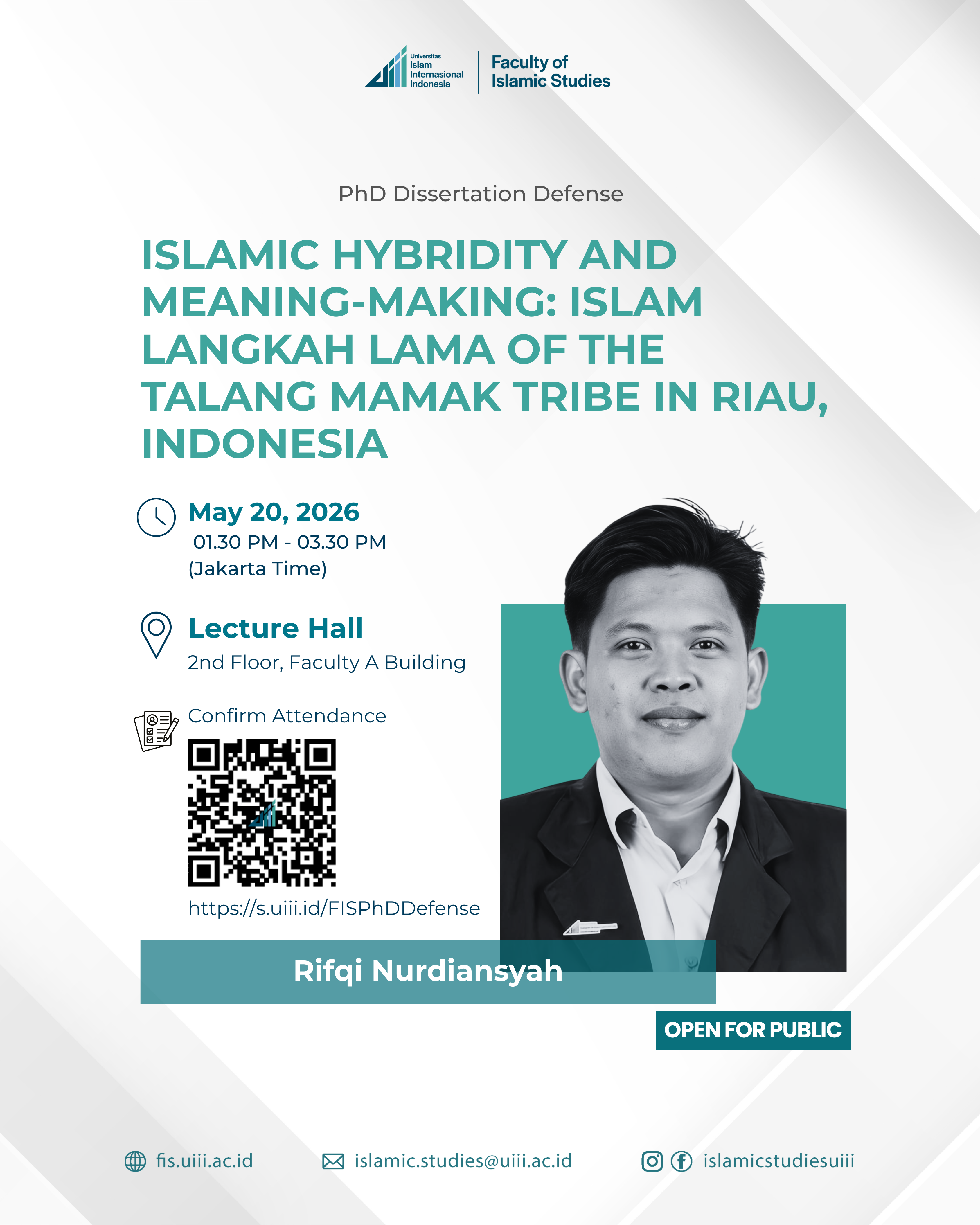
PhD Dissertation Defense [Open for Public]:
Islamic Hybridity and Meaning-Making: Islam Langkah Lama of the Talang Mamak Tribe in Riau, Indonesia
Abstract
This study investigates the religious and cultural system of the Talang Mamak tribe in Riau, Sumatra, locally known as Islam Langkah Lama. Historically marginalized within both academic and theological discourses, this community’s practices have frequently been mischaracterized as animism, dynamism, or “syncretic Islam”, a term heavily burdened by normative, hierarchical, and pejorative connotations. Challenging these reductionist classifications, this dissertation proposes the framework of Islamic Hybridity. Drawing upon Homi K. Bhabha’s concept of the “Third Space,” this study views Islam not as a static doctrinal essence, but as an evolving, power-laden cultural formation. To address the anti-essentialist limitations of postcolonial theory, this research introduces the concept of Bounded Hybridity. Unlike the endlessly fluid hybridity of conventional theory, the Islamic Hybridity of the Talang Mamak retains a definitive essence, firmly anchored by a stable ontological horizon: the Shahādah (profession of faith) and the principle of Tawḥīd.
The study examines Islam Langkah Lama across four interconnected domains. First, it explores Cultural Hybridity, initiated in the fourteenth century through the adoption of Minangkabau Adat, specifically the Bodi-Caniago harmony, via Datuk Patih Nan Sabatang. Operating as a mode of mimicry, the Talang Mamak rearticulated these traditions to form the ecological bedrock of their forest-dwelling society. Second, it analyzes Political Hybridity, which emerged in the sixteenth century under the Indragiri Sultanate. Functioning as as hamba raja (royal subjects) and bounded by sacred oath (sumpah sakti), the community integrated Islamic socio-legal elements under the protection of the Sultanate. Crucially, this era, followed by the later diaspora of Banjar Muslims, facilitated the circulation of texts like the Kitab Barencong, laying the theological foundation of waḥdat al-wujūd (Unity of Being). Third, the study uncovers Religious Hybridity in the postcolonial era, observing the community’s negotiation with state-enforced religious institutionalization, Catholicism (Langkah Baru), and reformist Islam (Islam Langkah Baru). Despite these external pressures, the epistemological authority of Islam Langkah Lama remains the resilient core through which all affiliations are negotiated.
Fourth, the study examines the Meaning-Making Process as the ultimate framework of this hybridity, demonstrating how the Talang Mamak continually reproduce and localize Islamic meaning. Grounded in waḥdat al-wujūd metaphysics and the integration of practices like doʿa and dhikr, this epistemological foundation clarifies their perceived inattention to formal sharia. Rather than a theological deviation, their practices reveal a profoundly lived Sufi substratum. What outsiders often dismiss as “shamanistic” rituals are, in fact, vital mediating pathways to the Divine unseen (Allah Raib). This transcendent dimension is complemented by the visible manifestation of Divine truth embodied in the Prophet (Muhammad Nyata), linked to the concept of Nūr Muḥammad. By navigating this Third Space of ambiguity and negotiation, the community seamlessly integrates intermediary rituals while maintaining the absolute core of Tawḥīd, providing Islam Langkah Lama with the spiritual elasticity to remain resilient and adaptive.
Ultimately, this dissertation advances the Anthropology of Islam by conceptualizing the religion as a relational, historically constituted, and epistemically negotiated formation. Extending contemporary debates on Islam as a discursive tradition, the study demonstrates that religious authority for the Talang Mamak is cosmo-ritual rather than primarily textual or juristic. By recognizing peripheral, indigenous articulations of Islam as integral to the religion’s historical plurality, this study proves that the Talang Mamak are active producers of Islamic meaning, not passive recipients. It thus invites a reimagining of the conceptual map of Islam, recognizing such communities as custodians of a deep, enduring Islamic plurality whose spiritual centers reside not just in mosques, but in forests and ancestral lineages.
Resume
Rifqi Nurdiansyah has been a lecturer at the Faculty of Sharia, IAIN Kerinci, Jambi since 2019. He earned his Bachelor’s degree in Al-Ahwal Al-Syakhsiyah from Universitas Islam Tribakti (UIT Lirboyo), Kediri, East Java in 2013. In 2016, he obtained his Master’s degree in Islamic Law from UIN Sunan Kalijaga Yogyakarta.
He has also written numerous articles and opinion pieces, and has served as a journal reviewer for both national and international publications. He received the Second Place Award in the writing competition at the Indigenous Southeast Asian and Ethnic Studies event organized by UIN Sultan Maulana Hasanuddin Banten in 2025, and won First Place for Best Post-Research Dissertation at the Nusantara Academic Writing Award (NAWA), organized by Nusantara Institut in collaboration with Bank Central Asia and Djarum Foundation in the same year.
Details
Wednesday, May 20, 2026
01.30 PM – 03.30 PM (Jakarta GMT+7)
Lecture Hall, 2nd Floor, Faculty A Building, UIII
Assessment Committee
- Haula Noor, Ph.D (Chair)
- Bhirawa Anoraga, Ph.D (Secretary)
- Dr. Ade Jaya Suryani (Examiner 1)
- Prof. Syamsul Rijal, Ph.D (Examiner 2)
- Ridwan, Ph.D (Examiner 3)
Supervisors
- Prof. Yanwar Pribadi, Ph.D
- Dr. Phil. Zacky Khairul Umam