
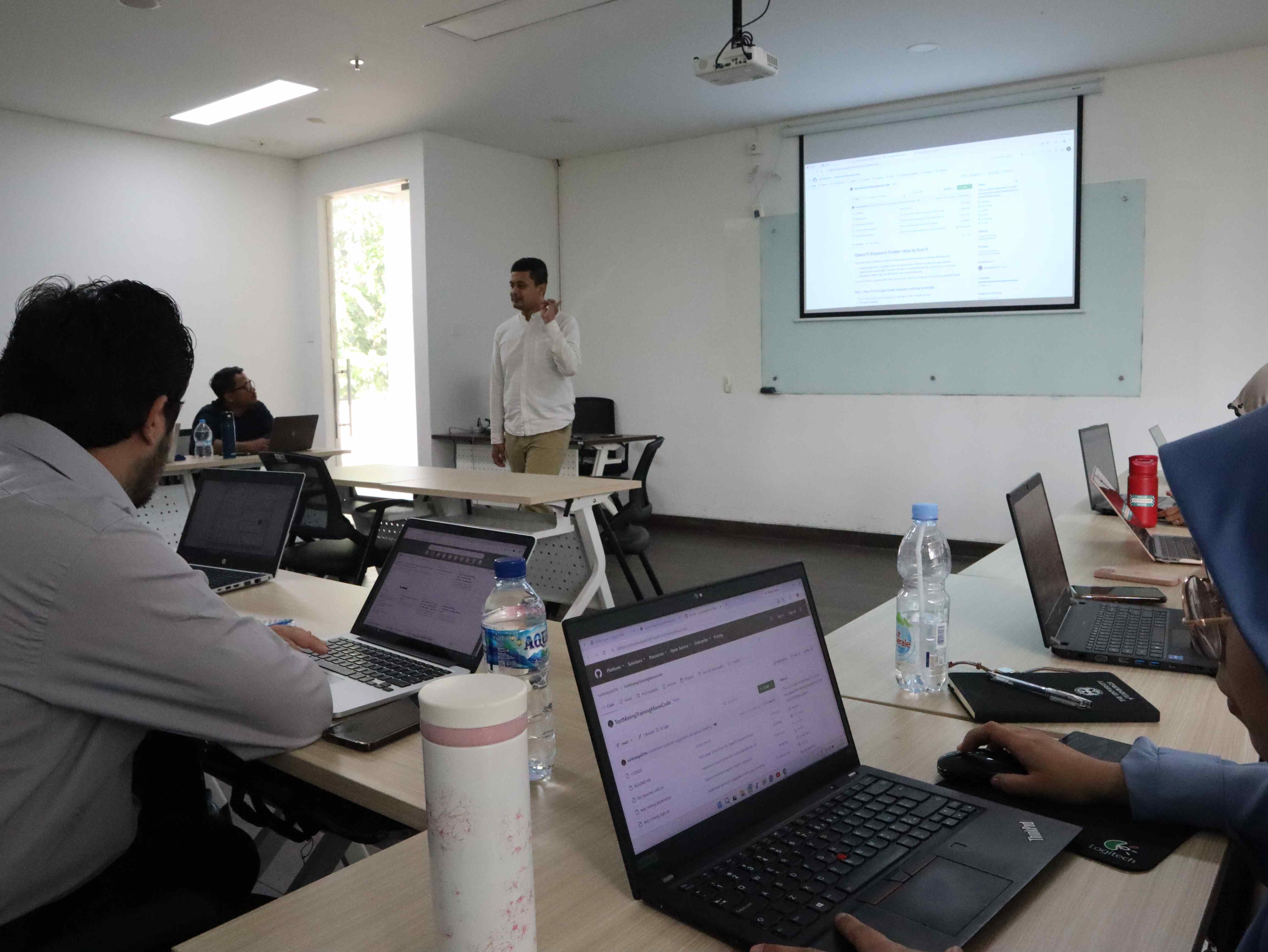
Depok — The Faculty of Islamic Studies, Universitas Islam Internasional Indonesia (UIII) invited Dr. Anggi Azzuhri, its recent graduate, to discuss the use of text mining and semantic search for Islamic studies research for its PhD students. Dr. Azzuhri is also an affiliated fellow of the Center of Islam and Global Challenges (IGC) at the faculty. The session reflects the university’s commitment to equipping students with implementing technology, like text mining, as part of contemporary methods in doing research.
The discussion was led by Dr. Haula Noor and attended by 12 PhD students of the 2026/2027 cohort. Through a 20-slide presentation and a hands-on practice session, Dr. Azzuhri emphasized that Digital Humanities (DH) can raise the quality of research in several ways, and text mining is among the most prominent. Text mining is the systematic search for patterns in text, whether frequency, repetition, or co-occurrence, across volumes far larger than any researcher can read or remember. It is especially valuable for researchers in Islamic studies, whose literature is vast and cannot realistically be read in full by one person. DH now makes it possible to analyze hundreds of thousands of pages at once.
Participants were introduced to two modes of reading. Using AI to process large corpora is known as distant reading. It begins with questions such as how often a term appears across a corpus, what patterns surround it, and how those patterns change. Close reading is the researcher’s manual, word-by-word engagement with a text, and it begins with a different question: what does this word, sentence, or paragraph mean?
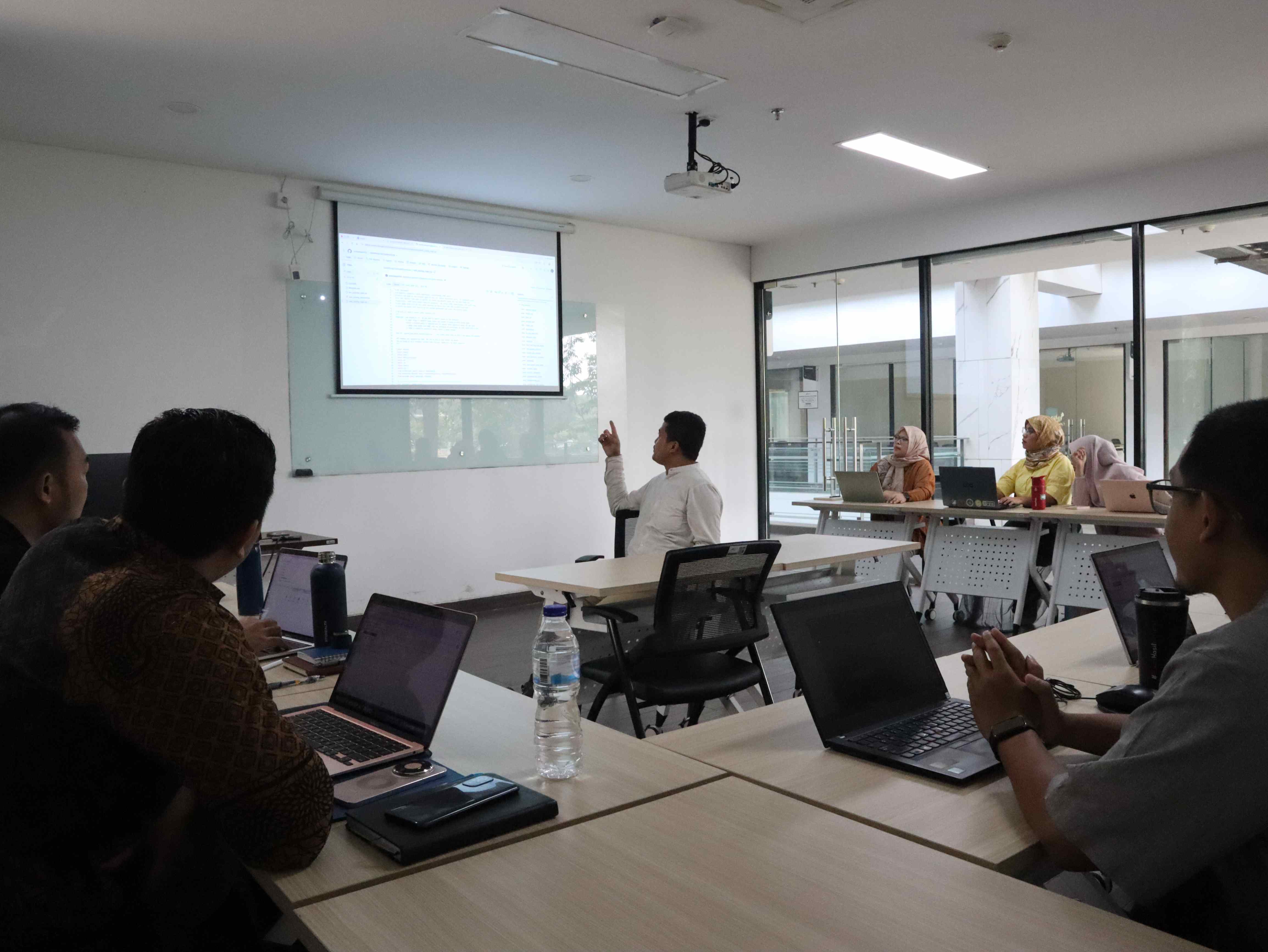
The discussion then turned to semantic search. This method applies AI language models to convert words and passages into numerical representations of their meaning, known as embeddings, and then retrieves the passages whose meaning is closest to researcher’s query. Conventional keyword search finds only the exact words a researcher types. Semantic search retrieves passages by meaning, so a query can surface relevant material even when the wording differs.
In Islamic studies, this opens new possibilities. For example, a researcher studying the concept of public interest (maṣlaḥah) in classical legal works could search for the term itself and still miss passages where jurists discuss the same idea in other words, such as benefit (manfa’ah) or the prevention of harm (daf’ al-mafsadah). A semantic search using a query that describes the idea can bring up these related discussions across works of fiqh, usūl al-fiqh, and commentary, without the researcher knowing in advance which words each author used. The researcher can then read the retrivied passage closely and judge their relevance. Where text mining asks how often and where, semantic search asks what is related to this idea.
The session was not limited to theory. Participants learned to run text mining themselves, working in Google Colab with code prepared in advance by Dr. Azzuhri. Each participant could experience the full process of text mining and semantic search firsthand, using search terms relevant to their own research.
According to Dr. Azzuhri, both approaches depend on three core skills: formulating a precise question, preparing and normalizing data, and verifying output against the source.
“AI can write the syntax for you. It cannot decide what counts as the same word, what pattern matters, or whether a result is historically plausible,” he said. “At this scale, verification is harder, not easier. A semantic match can look plausible and still be wrong. That is more reason the judgment stays yours, not less.”
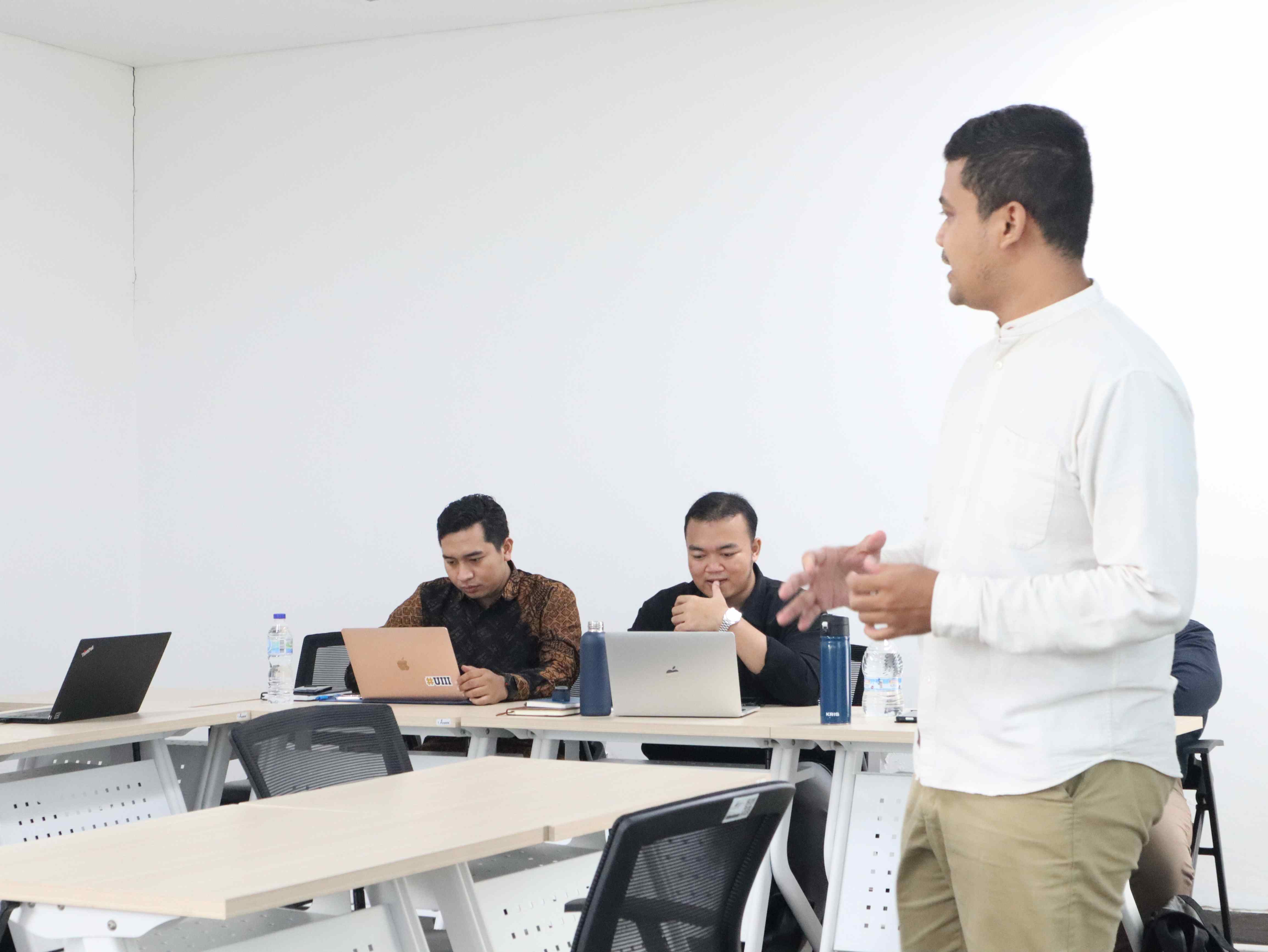
He also cautioned that, however powerful, Digital Humanities is not a universal solution. Its methods have limits and do not suit every field of inquiry. Ultimately, the quality of research rests on the researcher: framing the question, analyzing the data, and verifying the validity of the results.
The clinic closed with a remark attributed to computer scientist Alan Perlis: “There are two ways to write error-free programs; only the third one works.” The humor lies in the third way, which never actually exists. The joke suggests that no method guarantees a flawless result, and that perfection is out of reach. For researchers using computational methods, the lesson is that no output can be trusted on its own. Results must always be tested, checked against the source, and corrected, as a continuing part of the research process rather than a final step.
It is this spirit of rigor that underpins UIII’s commitment to its researchers. By bringing Digital Humanities into the training of its PhD students, the university affirms its resolve to prepare scholars who are rooted in the Islamic intellectual tradition and equipped to engage it with contemporary tools and sound judgment. UIII will continue to strengthen its research methodology training, so that new technologies serve, rather than replace, the careful scholarship on which Islamic studies depends.