
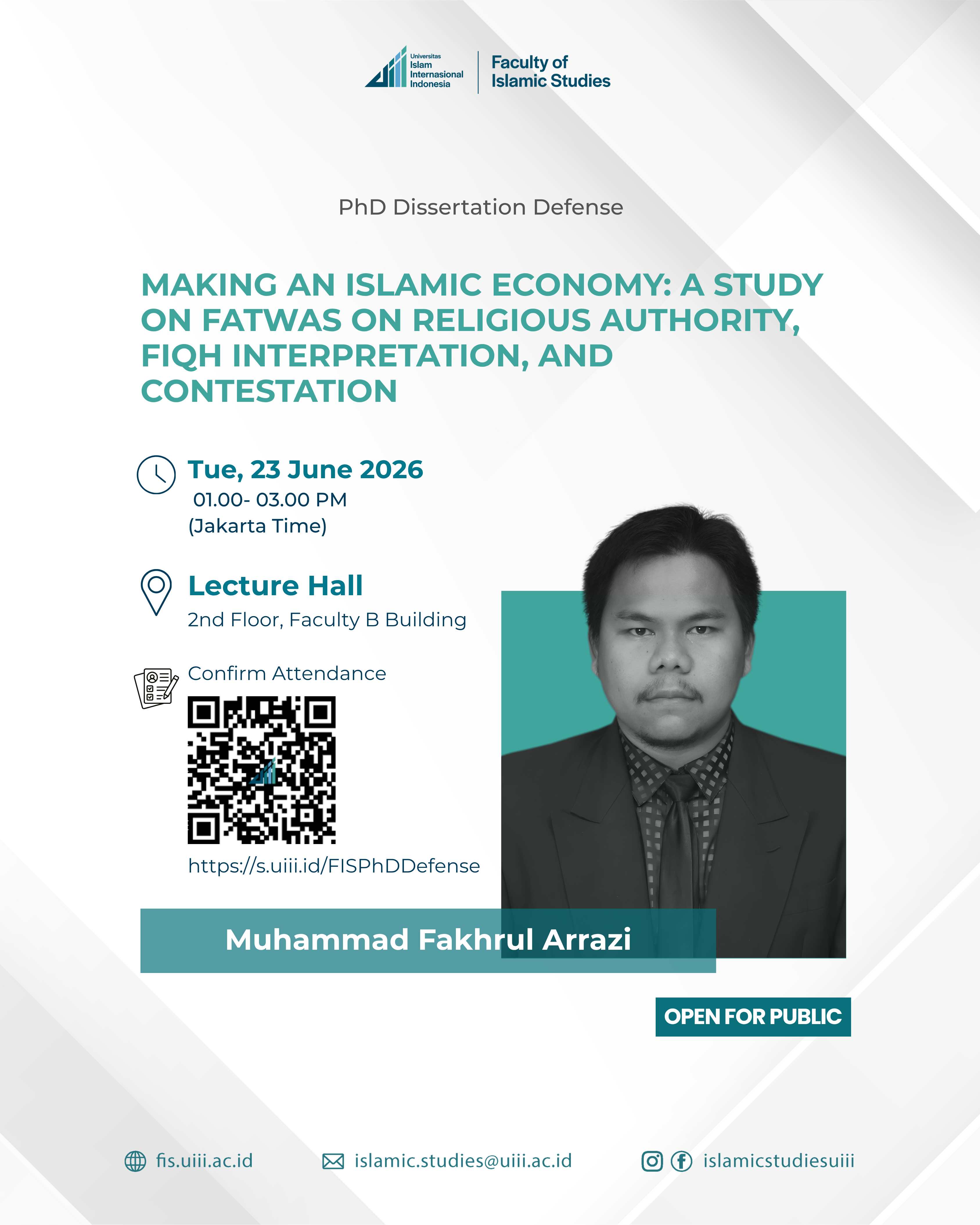
PhD Dissertation Defense of Muhammad Fakhrul Arrazi [Open for Public]:
Making an Islamic Economy: A Study on Fatwas on Religious Authority, Fiqh Interpretation, and Contestation
Abstract
This dissertation examines the complex dynamics of Islamic economic fatwa-making in Indonesia by positioning them at the intersection of shariah governance, religious authority, and socio-political contestation. The study analyzes how fatwas operate as vital instruments within the shariah governance framework in Indonesia, through a mechanism of indirect legalization. DSN–MUI, as a non-state institution, acquires operational power for its fatwas via incorporation into state regulations. However, despite the recognition, this research argues that the institutional role of DSN–MUI is characterized by specific jurisdictional and structural boundaries stemming from its status as a civil society organization. These role limitations create a contested normative space, that facilitates the emergence of alternative religious authorities.
Through what this study conceptualizes as “Salafinomics,” the Salafi community affiliated with Perhimpunan Al-Irsyad rises to challenges DSN–MUI’s interpretive dominance. Utilizing a qualitative case study approach, this research identifies a sharp epistemological divide. On the one hand, DSN–MUI adopts a pragmatic and contextualist methodology, employing makhārij fiqhiyyah, and is influenced by the Al-Azhar intellectual tradition. On the other hand, Salafi actors adhere to a strict textualist and literalist approach influenced by Ibn Taymiyah references and Saudi-trained scholarly orientations. These methodological differences are manifested in significant disagreements over many issues.
Religiously, sociologically, and politically, this contestation is expressed through five dimensions: the struggle between legal-rational and moral-normative legitimacy; substantive juristic debates; a communication gap resulting in the symbolic marginalization of Salafi actors; divergent dissemination strategies using formal vs. digital-grassroots channels; and a scholarly rivalry between Egyptian and Saudi-trained alumni. Ultimately, the dissertation concludes that the persistent delegitimization of official fatwas by influential Salafi preachers poses a “ticking time bomb” for public trust in the national Islamic financial ecosystem. Therefore, proactive institutional harmonization is necessitated to safeguard social cohesion and industry stability.
Keywords: Islamic Economy, Fatwa, DSN–MUI, Salafinomics, Religious Authority, Shariah Governance, Indonesia.
Resume
He currently serves as a Civil Servant Teacher at the Ministry of Religious Affairs of Aceh Province. He earned his Bachelor’s degree in Shariah Islamiyah (Islamic Law) from Al-Azhar University, Cairo, Egypt, and his Master’s degree in Shariah with a concentration in Islamic Economics from the University of Malaya, Kuala Lumpur, Malaysia.
Details
Tuesday, 23 June 2026
01.00 – 3.00 PM (Jakarta GMT+7)
Lecture Hall, 2nd Floor, Faculty B Building, UIII
Assessment Committee
- Haula Noor, Ph.D. (Chair)
- Bhirawa Anoraga, Ph.D. (Secretary)
- Zezen Zaenal Mutaqin, S.J.D. (Examiner 1)
- M. Luthfi Hamidi, Ph.D. (Examiner 2)
- Prof. Alfitri, M.Ag., LL.M., Ph.D. (Examiner 3)
Supervisors
- Dr. Phil. Syafiq Hasyim (Supervisor)
- Prof. Syamsul Rijal, Ph.D. (Co-Supervisor)