
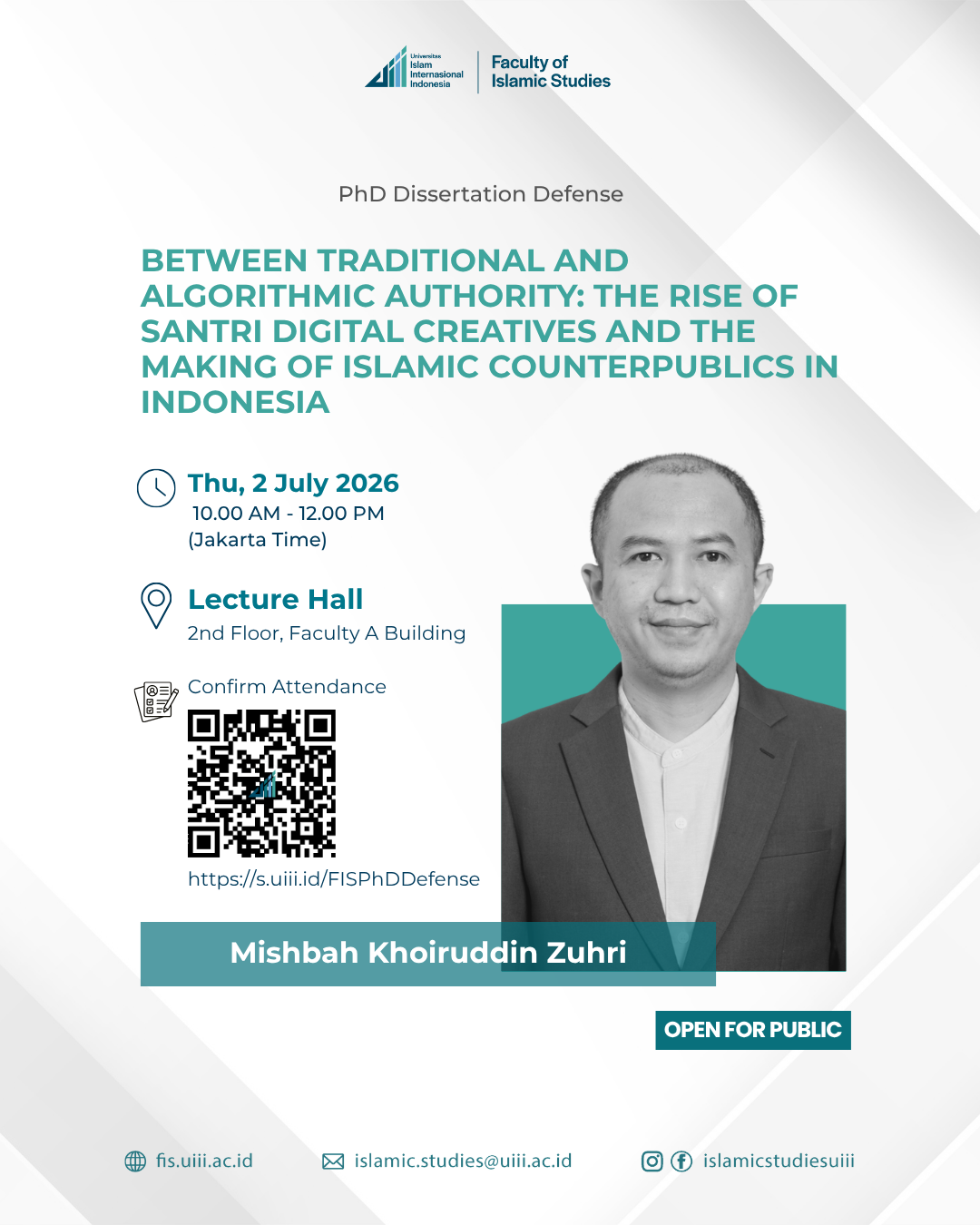
PhD Dissertation Defense of Mishbah Khoiruddin Zuhri [Open for Public]:
Between Traditional and Algorithmic Authority: The Rise of Santri Digital Creatives and The Making of Islamic Counterpublics in Indonesia
Abstract
This study examines the rise of Santri Digital Creatives (SDCs) during the post-reform era in the 2010s. They are digital curators and creators from pesantren (Islamic boarding schools) utilize online platforms to translate and distribute traditional Islamic teachings. I argue that SDCs have played important role in shaping traditional religious authority in digital sphere. The study focuses on kiai Ahmad Bahauddin Nursalim (Gus Baha), a popular Indonesian ulama on social media. He is a figure who represents traditional authority. His legitimacy rests on sanad (chain of knowledge transmission) and nasab (genealogical lineage). He articulates classical Islamic texts (turāth) with the principles of ease (yusr), joy, and humor to address contemporary challenges. However, without personal social media accounts, his traditional authority was restricted to local pesantren community, creating a gap in digital visibility. SDCs bridge this gap by providing algorithmic authority. Nevertheless, some of them attempt to maintain the traditional authority of Gus Baha. This study highlights the complexity of SDCs in shaping the religious authority by negotiating traditional authenticity and algorithmic visibility.
This study employs digital ethnography to investigate the religious reproduction of SDCs by integrating physical immersion in pesantren with virtual observation across digital platforms. Fieldwork includes attendance at the ngaji (intensive study of classical Islamic texts) sessions of Gus Baha in Kudus, Rembang and Jakarta, alongside interviews with SDCs, audience members and religious leaders. The study tracks digital labor via participant observation on Website, YouTube, Instagram and Facebook, while monitoring WhatsApp and Telegram communities to analyze internal interactions. Through digital methods, including API (Application Programming Interface) data extraction for hashtag analysis of #GusBaha and website traffic growth analysis, the study measures the reach of traditionalist narratives in a polymedia environment.
This study argues that SDCs negotiate the tension between traditional authority and algorithmic authority. SDCs perform three roles in mediating traditional religious authority within the digital space. These roles are categorized as Institutional, Independent, and Organic actors. These roles create a multi-layered defense for traditionalist authority amidst the dominance of social media algorithms. Institutional actors function as official digital spokespersons for kiai figures and pesantren institutions. The primary focus of this group is to safeguard authenticity by prioritizing traditional authenticity over algorithmic popularity. They seek to reconstruct the physical boundaries of offline ḥalaqah (traditional study circles) within a virtual environment by uploading full-length, long-duration recordings. Adapting their everyday pesantren traditions to the digital sphere, they emphasize spiritual values, such as the importance of maintaining ritual purity (wuḍū’) for the digital audience. This specific digital labor serves as a form of khidmah (devotional service) to seek barakah (blessings). They limit commercial tactics such as provocative or sensational titles.
Independent actors serve as digital strategists who bridge the gap between pesantren traditions and the modern world. Although they operate outside formal institutional structures, this group remains rooted in the santri intellectual tradition. They function as cultural translators who negotiate the format, meaning, and aesthetics of traditional teachings. Their goal is to make these teachings more relevant for urban millennials. They strive to build a moderate Islamic counterpublic by providing Indonesian subtitles for regional lectures or adopting elements of popular culture. This effort serves as a bulwark against the influence of radical ideologies in cyberspace. These strategic practices remain rooted in the santri intellectual tradition.
Organic actors act as digital entrepreneurs, consisting of anonymous channel managers or grassroots marketers. They utilize the logic of social media algorithms to achieve mass visibility and economic gain. They possess the skill to repackage lengthy religious materials into viral and short clips. They operate outside the kiai-santri hierarchy and lack the ethic of khidmah. They monetize the religious figure to prioritize advertising revenue over spiritual devotion. They expand the reach of the kiai’s authority into a popular brand of faith. Their practices often operate without a formal license or ijāzah. This poses a risk to the contextual integrity of classical religious texts. Content distribution in this specific dimension relies on digital engagement metrics rather than substance.
This study contributes by analyzing the interaction between traditional authority and algorithmic authority. It expands the discourse on authority and media, a field dominated by Western perspectives that focus on digital creatives and algorithmic logic. The research asserts that traditional authority remains a factor in religious legitimacy within cyberspace and persists despite technological developments. The study demonstrates that the attention economy does not only define the digital labor of SDCs. While some actors prioritize platform metrics, others are guided by religious moral values such as khidmah and barakah. Through the categorization of institutional, independent, and organic actors, the study shows how sanad and kitab kuning based legitimacy transforms into digital visibility. This study expands the discourse on authority and media, a field dominated by Western perspectives that focus on digital creatives and algorithmic logic.
Resume
He currently serves as a Lecturer at the Faculty of Ushuluddin and Humanities, UIN Walisongo Semarang. He earned his Bachelor’s degree in Tafsir and Hadis from UIN Walisongo Semarang, Indonesia, and his Master’s degree in Islamic Studies from Hamad bin Khalifa University, Doha, Qatar.
Details
Thursday, 2 July 2026
10.00 AM – 12.00 PM (Jakarta GMT+7)
Lecture Hall, 2nd Floor, Faculty A Building, UIII
Assessment Committee
- Farid Fachruddin, Ph.D. (Chair)
- Dr. A. Mughzi Abdillah (Secretary)
- Prof. Dr. Bart Barendregt (Examiner 1)
- Prof. Syamsul Rijal, Ph.D. (Examiner 2)
- Najib Kailani, Ph.D. (Examiner 3)
Supervisors
- Prof. Yanwar Pribadi, Ph.D. (Supervisor)
- Bhirawa Anoraga, Ph.D. (Co-Supervisor)