
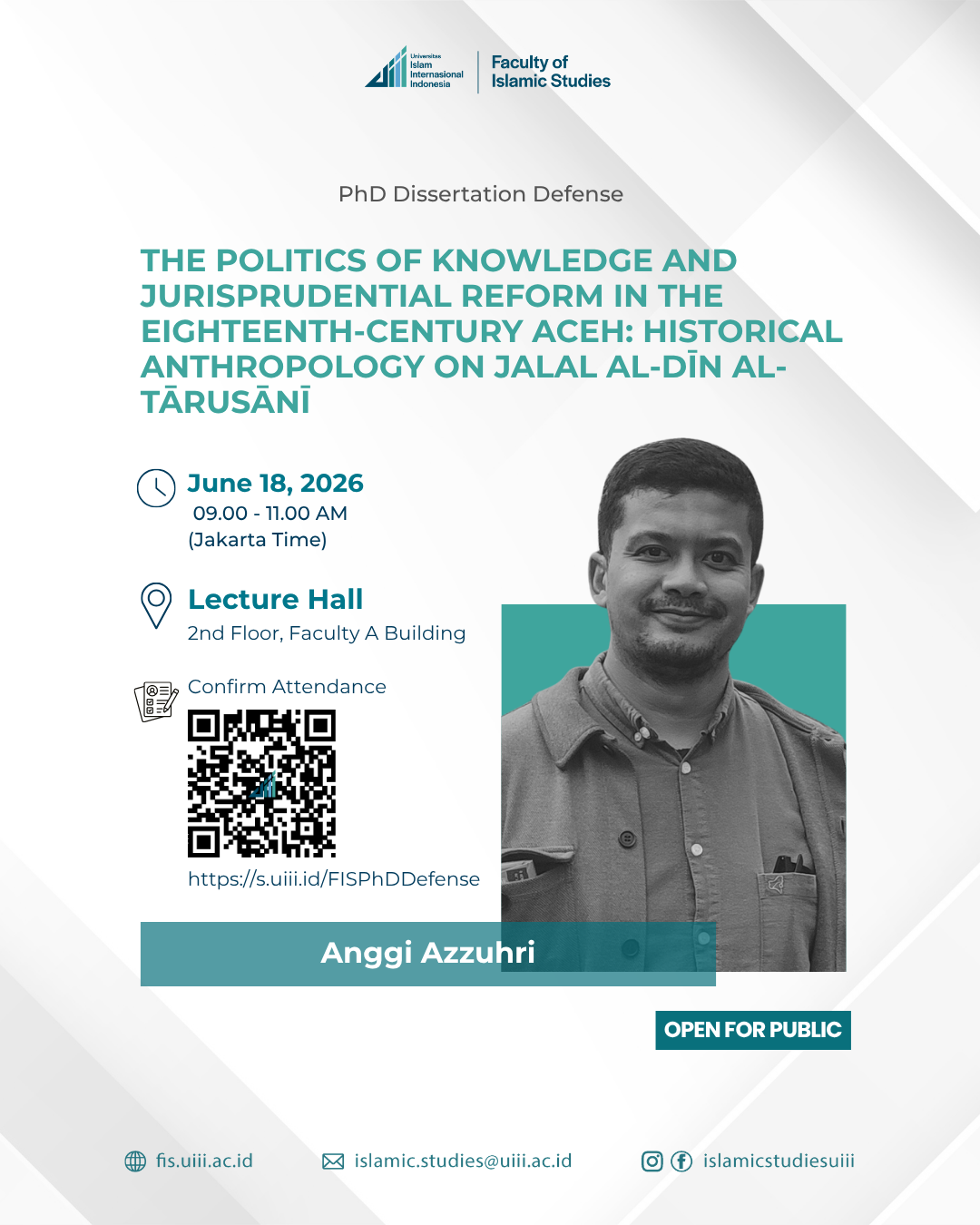
PhD Dissertation Defense of Anggi Azzuhri [Open for Public]:
The Politics of Knowledge and Jurisprudential Reform in Eighteenth-Century Aceh: Historical Anthropology On Jalal Al Dīn Al-Tārusānī
Abstract
In modern Aceh, a profound socio-legal paradox persists, namely, indigenous customary practices (adat)—even those seemingly contradicting mainstream traditional jurisprudence, such as the galā mortgage contract—are unequivocally perceived as fully compliant with the Sharīʿa. To understand how a local norm became psychologically and socially equated with divine law, this dissertation investigates the eighteenth-century intellectual reformation spearheaded by the Acehnese jurist Jalāl al-Dīn al-Tārūsānī. Through a close historical and anthropological reading of his legal manual, Safīnat al-Ḥukkām, the research asks how al-Tārūsānī navigated the global Shāfiʿī rivalries of the Meccan-Cairene split to architect this enduring legal synthesis. At the micro-level, the study traces al-Tārūsānī’s highly specific textual maneuvering. Operating within the theoretical framework of the “politics of knowledge,” it reveals how he deliberately bypassed the rigid, Arab-centric gatekeepers of oral transmission (isnād). Instead, he gauged an independent text-based critical reading (muṭālaʿa wa fihrist), which granted him the epistemological flexibility to mobilize theoretical maxims from complex transregional texts like al-Suyūṭī’s al-Ashbāh wa’l-Naẓāʾir. Through pragmatic eclecticism, he synthesized Shāfiʿī and Ḥanafī principles and utilized marginalized legal opinions to legitimize deeply embedded socio-economic realities, ranging from indigenous measurement scales to female empowerment in determining marital suitability (kufuʾ). By elevating institutionalized state custom—encompassing Sultanic decrees, Qanun, and Reusam—into a valid, codified extension of the Sharīʿa, al-Tārūsānī pioneered an early “codification spirit” long before modern legal reforms. Ultimately, this dissertation challenges the colonial center-periphery dichotomy that reduces Southeast Asian Islam to a passive recipient of Middle Eastern orthodoxy. It argues that the Acehnese fiqh-adat paradigm was not a confused mix of local habit and imported religion, but a deliberate jurisprudential innovation that permanently redefined the landscape of Islamic law and praxis in the Malay world, in particular Aceh Sultanate in the 18th century onwards.
Resume
He currently serves as an Independent Software and AI Engineer. He earned his Bachelor’s degree in Arabic Education from UIN Ar-Raniry, Banda Aceh, Indonesia, and his Master’s degree in Islamic Studies from Hamad bin Khalifa University, Doha, Qatar.
Details
Thursday, 18 June 2026
09.00 – 11.00 AM (Jakarta GMT+7)
Lecture Hall, 2nd Floor, Faculty A Building, UIII
Assessment Committee
- Haula Noor, Ph.D. (Chair)
- Dr. Salahuddin Ayyub Fakhruddin (Secretary)
- Muhammad Al-Marakeby, Ph.D. (Examiner 1)
- Nia Deliana, Ph.D. (Examiner 2)
- Prof. Dr. Oman Fathurrahman (Examiner 3)
Supervisors
- Prof. Dr. Kautsar Azhari Noer (Supervisor)
- Zezen Zaenal Mutaqin, S.J.D. (Co-Supervisor)