
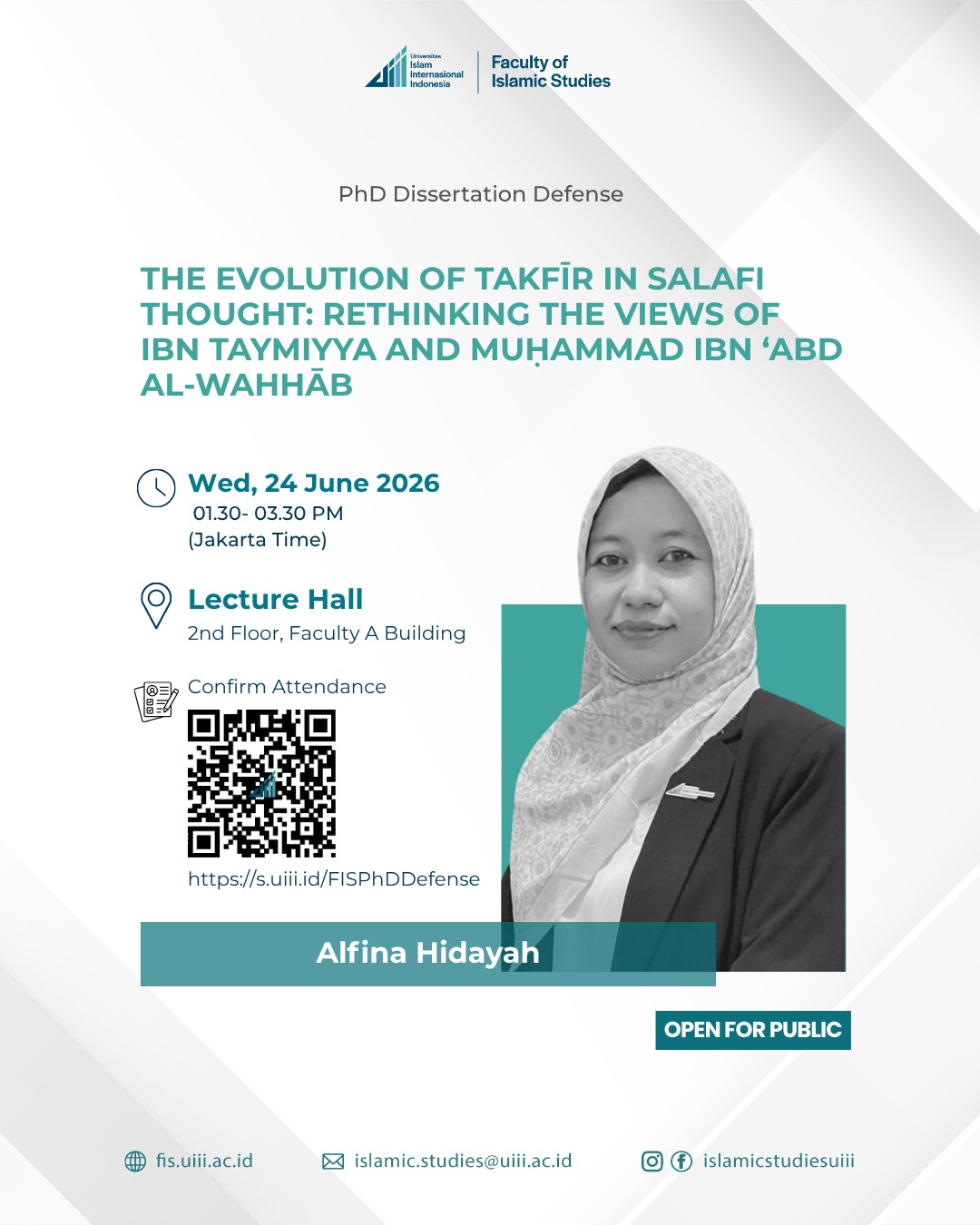
PhD Dissertation Defense of Alfina Hidayah [Open for Public]:
The Evolution of Takfīr in Salafi Thought: Rethinking the Views of Ibn Taymiyya and Muḥammad ibn ‘Abd al-Wahhāb
Abstract
This dissertation, titled “The Evolution of Takfīr in Salafi Thought: Rethinking the Views of Ibn Taymiyya and Muḥammad ibn ‘Abd al-Wahhāb,” examines the intellectual genealogy and doctrinal transformation of takfīr (the accusation of unbelief). Contemporary extremist militant groups frequently justify their actions by referring to the fatwas of earlier scholars, particularly Ibn Taymiyya and Muḥammad ibn ‘Abd al-Wahhāb. Although many scholars view Ibn ‘Abd al- Wahhāb as an admirer and successor who Ibn Taymiyya greatly influenced, there is, in fact, a gap in comparative theological research that would demonstrate whether this ideology of takfīr represents a continuation of an intellectual legacy or a deviant transformation. The study asks how Salafi thought on takfīr evolved and when it diverged from mainstream Sunni perspectives, focusing on how both scholars define the criteria of unbelief, their alignment with mainstream scholarship, and their comparative application of takfīr. Although this study mainly focuses on intellectual history, it also employs a socio-historical approach to the contexts of the Mamluk period and eighteenth-century Arabia. The findings show that Ibn Taymiyya largely represents continuity with the mainstream Sunni approach, especially through his cautious juridical conception of takfīr, grounded in the recognition of legal obstacles such as ignorance, coercion, and misinterpretation. However, a shift appears with Muḥammad ibn ‘Abd al-Wahhāb’s more expansive and instrumental use of takfīr. He broadened shirk to include practices such as tawassul and grave visitation and reduced traditional constraints, leading to a more exclusionary application of takfīr. The study concludes that Salafism should not be seen as a monolithic tradition but a shifting intellectual movement marked by a significant transformation from procedural legal restraint to a more expansive doctrinal deployment of takfīr.
Resume
She has served as a lecturer in the Aqidah and Islamic Philosophy Program, Faculty of Ushuluddin and Dakwah, UIN Raden Mas Said Surakarta, Indonesia, since 2019. She received her B.A. (Hons.) and M.Phil. in Aqeeda and Comparative Religion from the International Islamic University Islamabad (IIUI), Pakistan. Her academic work focuses on Islamic theology, Taymiyyan studies, and the modern reception of classical Islamic fatwas, with particular attention to jihād, radicalism, and takfīr. Her LITAPDIMAS-funded research project, “Muslihat Fatwa Jihad: Telaah atas Legitimasi Fatwa Ibn Taimiyyah sebagai Akar Pemikiran Radikalisme”, reflects her broader concern with the contested legacy of Ibn Taymiyya in modern Muslim thought. Her relevant publications include “The Misinterpretation of Ibn Taymiyyah’s Mardin Fatwa by the Modern Jihadist,” and “The Contextual Origin of Ibn Taymiyyah’s Thought on Jihad,”. She was selected as a recipient of the UIII Publication Incentive Program in 2023 and 2024 for her several scientific publications. Her current dissertation further develops this scholarly trajectory by examining the intellectual genealogy and doctrinal transformation of takfīr from Ibn Taymiyya to Muḥammad ibn ʿAbd al-Wahhāb.
Details
Wednesday, 24 June 2026
01.30 – 3.30 PM (Jakarta GMT+7)
Lecture Hall, 2nd Floor, Faculty A Building, UIII
Assessment Committee
- Prof. Syamsul Rijal, Ph.D. (Chair)
- Mahmoud Ali Gomma Afifi, Ph.D. (Secretary)
- Dr. Phil. Zacky Khairul Umam (Examiner 1)
- Zezen Zaenal Mutaqin, S.J.D. (Examiner 2)
- Dr. Sunarwoto, S.Ag., M.A. (Examiner 3)
Supervisors
- Prof. Dr. Kautsar Azhari Noer (Supervisor)
- Muhammad Al-Marakeby, Ph.D. (Co-Supervisor)