
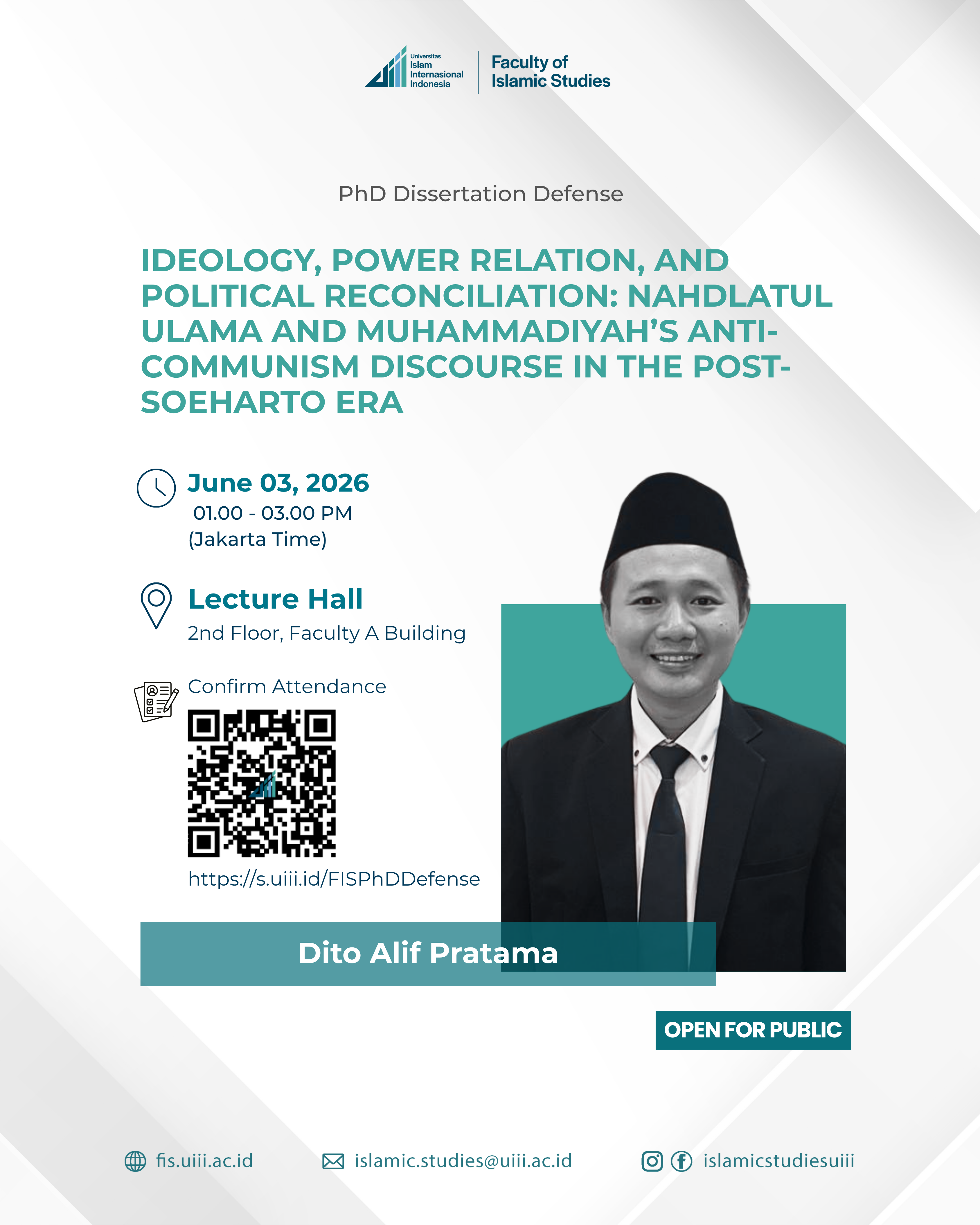
PhD Dissertation Defense [Open for Public]:
Ideology, Power Relation, and Political Reconciliation: Nahdlatul Ulama and Muhammadiyah’s Anti-Communism Discourse in the Post-Soeharto Era
Abstract
This dissertation examines the transformation of anti-communism discourse in Indonesia after the fall of Soeharto with a focus on Nahdlatul Ulama (NU) and Muhammadiyah. This study argues that the discourse of anti-communism is not only as a historical legacy of the New Order but also an evolving discourse that continues to shape contemporary political and religious life in Indonesia. This dissertation adopts a qualitative comparative study, focusing on the period from 1998 to 2025, a timeframe that captures both the opening of Indonesian democratic sphere following the fall of Soeharto regime and recent efforts to reassert state influence over the discourse of anti-communism. Drawing on multiple sources, this study utilizes organizational documents such as the Muktamar (congress) materials of NU and Muhammadiyah from 1999 to 2022, along with AD/ART (organizational statutes) and internal guidelines, as well as media publications, with particular attention to materials published on the official websites of NU Online and Muhammadiyah.or.id. Using manual web scraping guided by keywords such as “communism,” “PKI,” and the “1965 tragedy,” I compiled a dataset capturing the articulation of anti-communism discourse in contemporary public spheres. As of 30 July 2025, the dataset from both websites comprises at least 61 articles from NU Online and 28 articles from Muhammadiyah.or.id. In addition, this study draws on a range of complementary sources, including symposium records on the issue of the communism and the 1965 tragedy; interviews and focus group discussions with 31 participants across different organizational levels and generations. These data are then analyzed using Robert M. Entman’s framing theory, structured around three interrelated dimensions: ideology, power relation, and political reconciliation.
At the ideological level, the findings show that both organizations sustain anti-communism through three interrelated belief structures: (1) the construction of communism as foreign and atheistic, which is incompatible with the Pancasila; (2) the persistence of historical stigma rooted in the violence associated with PKI, especially in 1948 and 1965; and (3) a continuing belief in the potential resurgence of communism. At the level of power relations, anti-communism functions as a strategic resource which is mobilized by both state actors and organizational structural level within NU and Muhammadiyah to legitimize authority and shape political alignments. Meanwhile, in terms of political reconciliation, the study finds that engagement with the legacy of 1965–1966 remains limited and conditional, constrained by enduring stigma and legal restrictions, thereby restricting more critical reinterpretations of the humanitarian tragedy in the past, particularly the 1965 tragedy.
The dissertation, further, advances the concept of “half-hearted reconciliation,” referring to a mode of engagement through which anti-communism is partially acknowledged within NU and Muhammadiyah while avoiding full accountability and meaningful structural transformation of both organizations. Overall, the study demonstrates that anti-communism in Indonesia is actively reproduced through the interaction of ideology, institutional power, and contested historical memory, shaping the boundaries of political discourse and limit the process of reconciliation in the post-Soeharto era.
Keywords: Anti-communism, Nahdlatul Ulama, Muhammadiyah, Political Reconciliation, Ideology, Power relation, Post-Soeharto
Resume
Dito is a lecturer at PTIQ University Jakarta, where he currently serve as the dean of the Faculty of Sharia and Islamic Law (2026–2031). Dito completed his bachelor’s degree at Walisongo State Islamic University (UIN) Semarang, Indonesia, and earned a master’s degree in peace, trauma, and religion from Vrije Universiteit Amsterdam in the Netherlands, both supported by full scholarships from the Ministry of Religious Affairs of the Republic of Indonesia.
Details
Wednesday, June 03, 2026
01.00 PM – 03.00 PM (Jakarta GMT+7)
Lecture Hall, 2nd Floor, Faculty A Building, UIII
Assessment Committee
- Prof. Syamsul Rijal, Ph.D. (Chair)
- Dr. A. Mughzi Abdillah (Secretary)
- Prof. Yanwar Pribadi, Ph.D. (Examiner 1)
- R. Alpha Amirrachman, Ph.D. (Examiner 2)
- Hakimul Ikhwan, S.Sos., M.A., Ph.D. (Examiner 3)
Supervisors
- Prof. Dr. Amsal Bakhtiar, MA. (Supervisor)
- Haula Noor, Ph.D. (Co-Supervisor)