
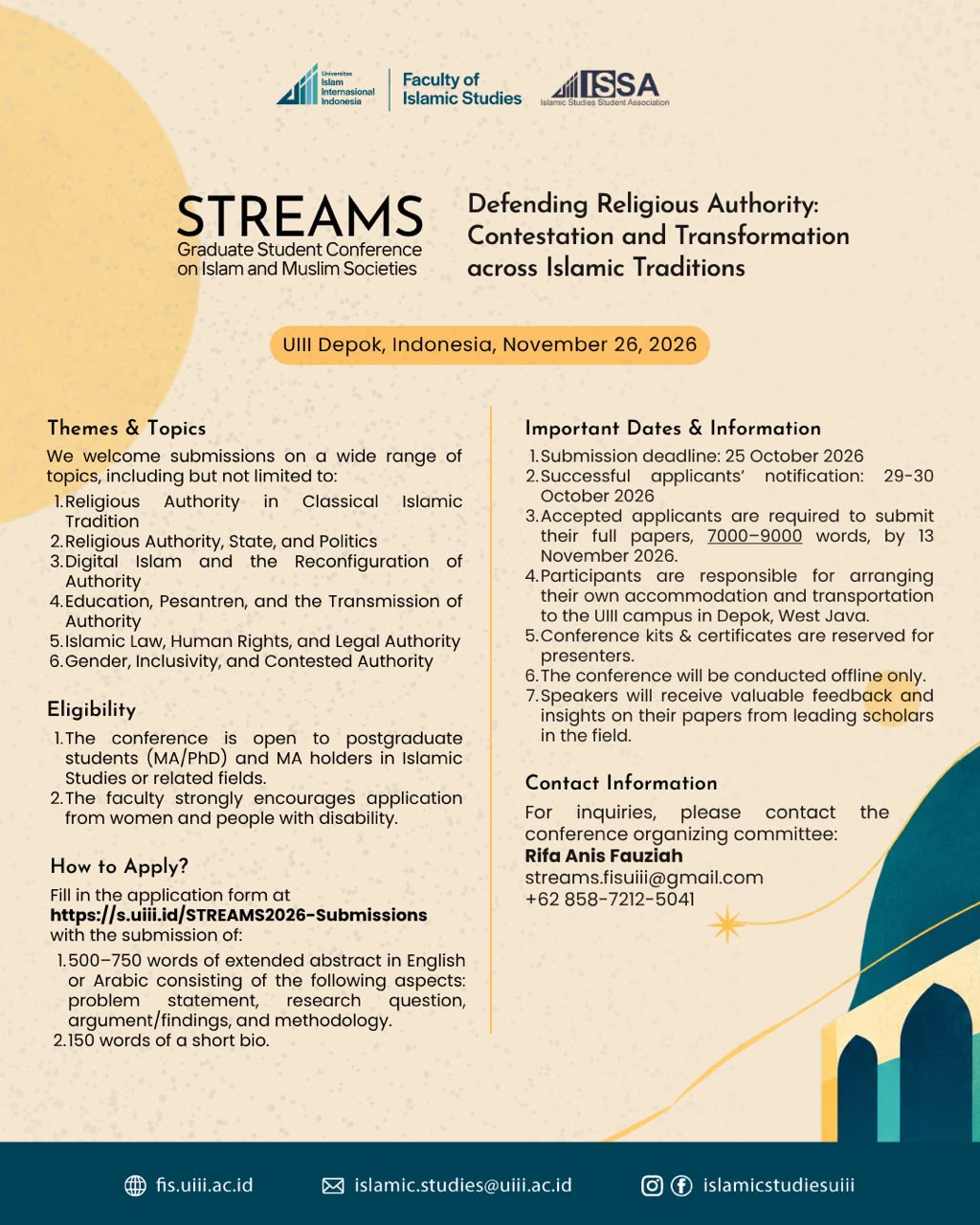
Defending Religious Authority: Contestation and Transformation across Islamic Traditions
About The Program
Religious authority in Islam has never been singular. It has always been constructed, negotiated, and contested, shaped by the intellectual climate of each era, the political landscape of each region, and the disciplinary norms of each field of Islamic scholarship.
In the second century of the Hijra, authority was forged through the rigorous chains of transmission (isnād) and the personal credibility of narrators (ʿadālah and ḍabṭ). By the time of Ibn Taymiyyah (d. 728 AH), religious authority was entangled with questions of state, theology, and the boundaries of ijtihād versus taqlīd. In al-Suyūṭī’s era (d. 911 AH), the encyclopedic scholar embodied a model of authority rooted in mastery across multiple disciplines. With Muḥammad ʿAbduh (d. 1323 AH) and the modern reform movement, the very foundations of traditional authority were interrogated: who may interpret, and on what terms?
Today, the question has taken on new urgency. Religious authority is no longer confined to the mosque, the madrasa, or the scholarly treatise. It circulates through social media algorithms, AI-powered fatwa applications, and viral TikTok sermons. A preacher with ten million followers may command more public influence than a classically trained muftī. An AI chatbot may issue a ruling faster than a council of scholars, but with what sanad, what accountability, and what consequences?
At the same time, the geography of authority has never been more varied. The criteria for who qualifies as a religious authority differ dramatically between Saudi Arabia and Indonesia, between India’s Deoband and Malaysia’s JAKIM, between a small pesantren in rural Java and the grand institutions of al-Azhar. Minority Muslim communities in Europe, East Asia, and the Americas construct authority structures shaped by entirely different pressures -legal, cultural, and demographic- than those in Muslim-majority societies.
This conference invites postgraduate students, early-career researchers, and established scholars to examine the making, unmaking, and remaking of religious authority in Islam, across centuries, across borders, across disciplines, and across platforms. We seek papers that are historically grounded yet responsive to contemporary realities, methodologically rigorous yet willing to cross disciplinary boundaries.
Speakers
To be announced later
To be announced later
To be announced later
To be announced later
Themes and Topics
- Religious Authority in Classical Islamic Tradition
- Religious Authority, State, and Politics
- Digital Islam and the Reconfiguration of Authority
- Education, Pesantren, and the Transmission of Authority
- Islamic Law, Human Rights, and Legal Authority
- Gender, Inclusivity, and Contested Authority
How to Apply?
- Participants are postgraduate (MA/PhD) students in Islamic Studies and related fields
- Submit 500 to 750-word extended abstracts in English or Arabic, consisting of the following aspects: problem statement, research question, methodology, argument/findings.
- Submit 150 words of a short bio
Date and Venue
- November 26, 2026
- Theatre Hall, Faculty A Building, UIII, Depok, Indonesia
Important Dates & Informations
- Submission deadline: 25 October 2026;
- Successful applicants’ notification: 29-30 October 2026;
- Accepted applicants are required to submit their full papers 7000-9000 words by 13 November 2026;
- Participants are responsible for arranging their own accommodation and transportation to UIII, Depok, West Java;
- Conference kits & e-certificates are provided only for the presenters;
- The conference will be conducted in-person (offline) only;
- Presenters will receive valuable feedback and insights on their papers from leading scholars in the field.
For Inquiries
- Email: streams.fisuiii@gmail.com | islamic.studies@uiii.acid
- WhatsApp: +62 858-7212-5041 (Rifa Anis Fauziah)