Looking ahead, the trajectory of Islamic studies at higher education institutions in Indonesia appears both vibrant and promising. With institutions such as UIII leading the way in shaping a model of scholarship that is at once grounded in the Islamic scholarly tradition and engaged with contemporary academia, and with Indonesian universities expanding postgraduate programmes and research output, I expect the field to continue to grow stronger.
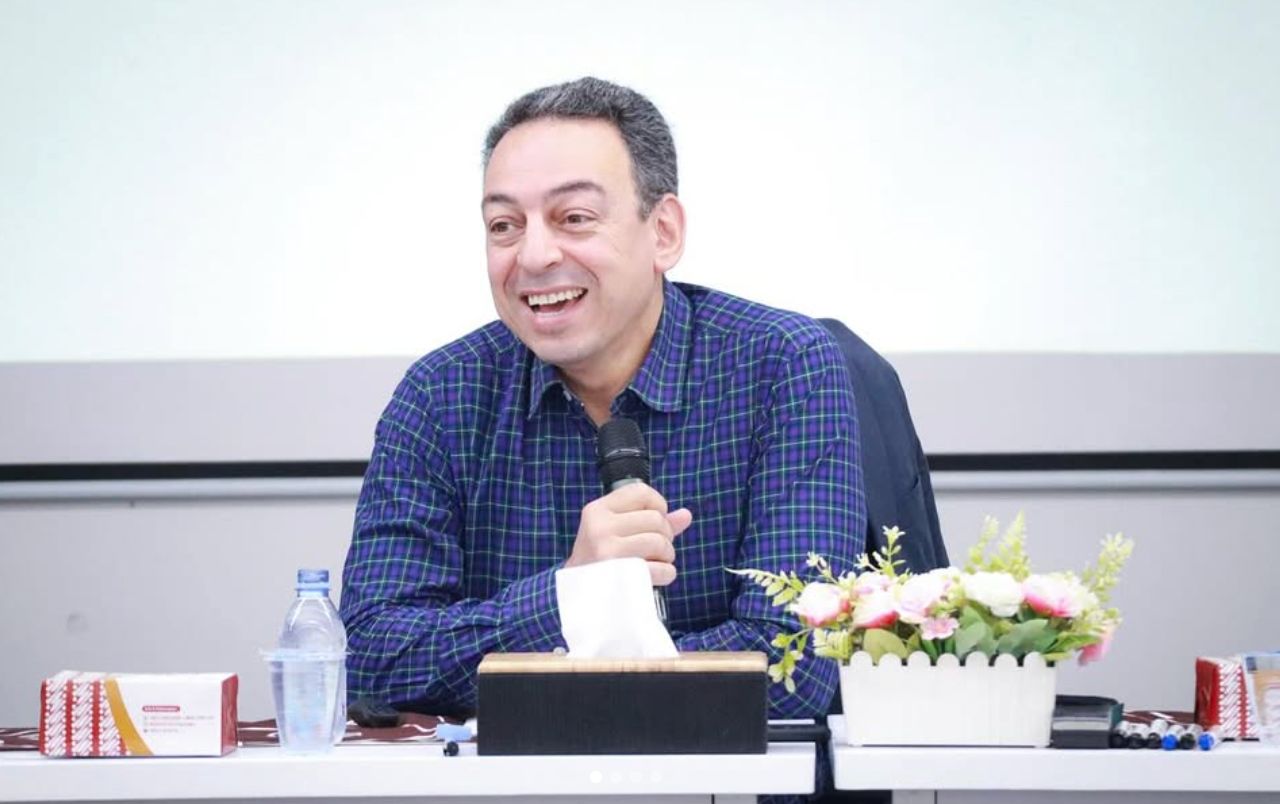
During late 2025, I had the privilege of spending around two months as a Senior Research Fellow at the Center of Islam and Global Challenges at the Indonesian International Islamic University in Depok. The fellowship afforded me a valuable opportunity to engage with faculty and students with shared interests both at the university and other Indonesian universities.
I very much enjoyed my stay at UIII and found it hugely beneficial. One of the most significant outcomes of the fellowship was the opportunity to build lasting scholarly relations with colleagues at UIII whose intellectual interests related closely to mine. The community of researchers I encountered at UIII — faculty and postgraduate students alike — was both deeply grounded in the Islamic scholarly tradition and engaged with contemporary academia. I had many fruitful discussions, from which I gained a great deal. This environment is not an accident, but a direct outcome of the Center’s and wider institution’s policy to foster serious, critical inquiry and an open, outward-looking perspective.
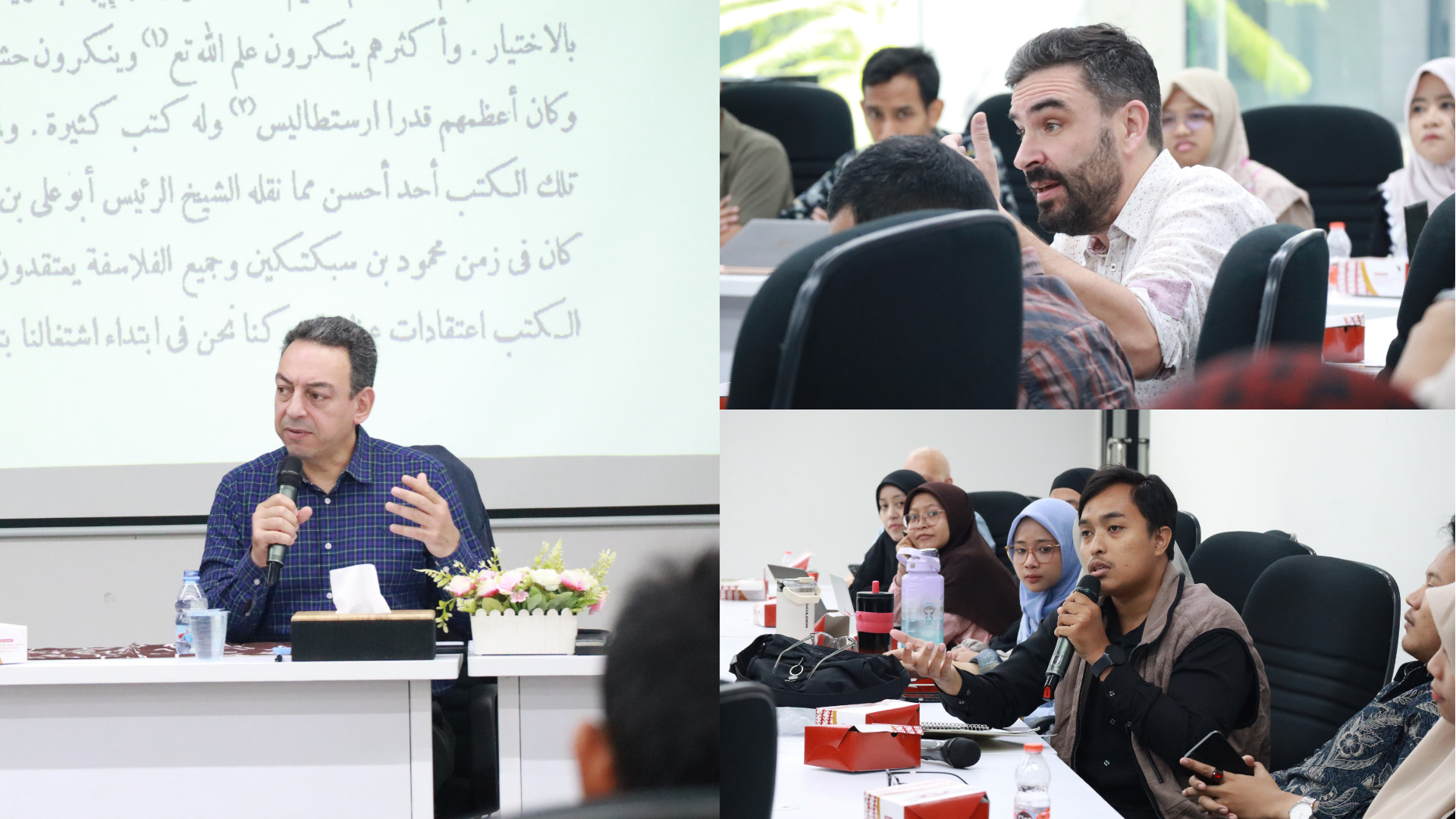
The fellowship also provided concentrated time to advance my own research. I was able to work on a project on the philosophical production of the great premodern thinker Fakhr al-Din al-Razi and to test my ideas through conversations with other researchers. A public lecture I delivered at UIII gave me the opportunity to present this research, and was followed by an excellent discussion, which provided helpful feedback on the paper. In addition, I had the opportunity to interact closely with postgraduate students at the University, and I delivered a class on Islamic manuscripts for doctoral students and attended presentations by doctoral students on their ongoing research projects. I also had individual meetings with master’s and doctoral students, in which we discussed their current studies and future plans.
My fellowship coincided with the Annual International Conference on Islamic Studies (AICIS 2025), which that year was hosted by UIII. I contributed to the first plenary session of the conference and benefited from the opportunity to meet scholars from universities across Indonesia. I also had the honour of attending the Rectors’ Forum at the conference, at which I spoke about the partnership between SOAS and UIII and partnerships with other Indonesian universities currently in development. The event provided a panoramic view of the breadth and vitality of Islamic studies in Indonesia today and served as an important occasion for me to build connections with academics and institutions beyond UIII.
The fellowship was furthermore an opportunity for a wider set of academic engagements across Indonesia. Over the course of my stay, I gave invited lectures at seven universities – in Jakarta, Bandung, Yogyakarta and Makassar – and met new colleagues at those institutions. These visits facilitated conversations about shared scholarly interests and long-term collaborations and gave me an opportunity to broaden my understanding of Indonesian academia.
A further outcome of the fellowship is that it enabled me to strengthen ties between UIII and my home institution, SOAS University of London. The two institutions already have a strong partnership in the form of a joint MA programme supported by the Ministry of Religious Affairs. During my stay, I met with students who will be coming to SOAS the following academic year, and with UIII leadership, I explored ways of developing and broadening the partnership between our two institutions. With the Dean of the Faculty of Islamic Studies, Professor Yanwar Pribadi, I also visited the Ministry of Religious Affairs in Jakarta and had constructive discussions about potential future collaborations involving SOAS.
Looking ahead, the trajectory of Islamic studies at higher education institutions in Indonesia appears both vibrant and promising. With institutions such as UIII leading the way in shaping a model of scholarship that is at once grounded in the Islamic scholarly tradition and engaged with contemporary academia, and with Indonesian universities expanding postgraduate programmes and research output, I expect the field to continue to grow stronger. Fellowship programmes such as the one I was on contribute to this trajectory by facilitating the exchange of ideas, supporting the formation of scholarly networks, and creating the conditions for collaborative research across institutional and national boundaries. In doing so, they play a vital role in consolidating Indonesia’s position as a significant and growing centre for Islamic studies at the international level.
Beyond the academic and institutional dimensions, I found the fellowship a deeply enjoyable personal and cultural experience. It was a real pleasure to experience Indonesia – its cities, hospitality and cultural richness – for a period of several weeks. I am grateful not only for what I gained during my stay at the scholarly and professional levels, but also for the warmth and generosity with which I was received at UIII and everywhere else I visited in Indonesia.
I would especially like to express my gratitude and appreciation for the support provided by the faculty and members of the Center of Islam and Global Challenges and the wider university, and in particular to the Center’s Director, Dr. Farid Fachruddin, and Co-Director, Dr. Haula Noor who went out of their way to be an extremely hospitable, supportive and professional host, and to the previous Director, Dr. Muhammad al-Marakeby, who facilitated my visit. I would also like to thank the Dean, Professor Pribadi, and all other faculty staff of the Faculty of Islamic Studies and other parts of the university, who made this fellowship a wonderful and enriching experience for me.