
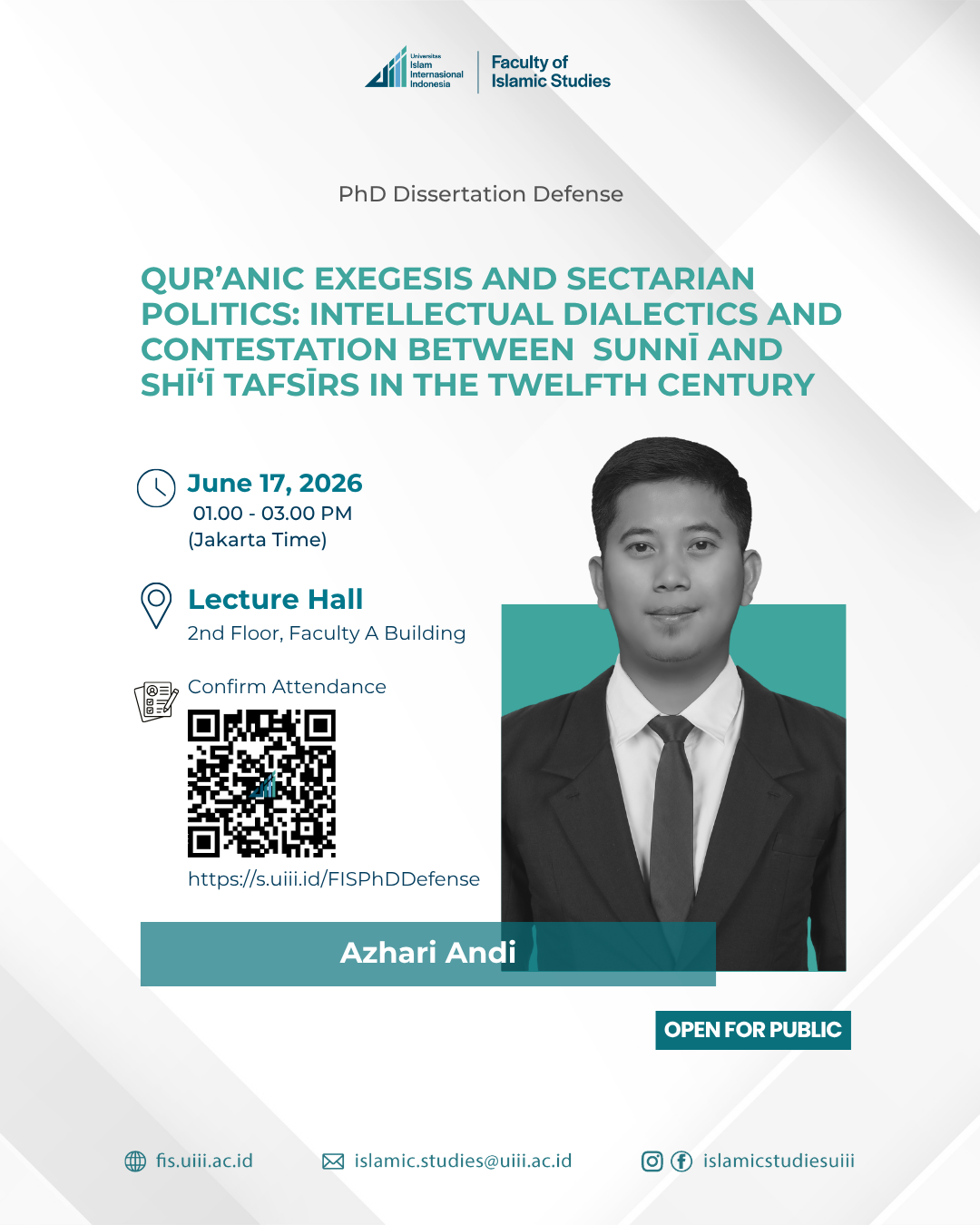
PhD Dissertation Defense of Azhari Andi [Open for Public]:
Qur’anic Exegesis and Sectarian Politics: Intellectual Dialectics and Contestation between Sunnī and Shī‘ī Tafsīrs in the Twelfth Century
Abstract
The twelfth century marks a significant period of political fragmentation within the Muslim world, particularly Sunnī and Shī‘ī. The fragmentation was not limited to the political sphere but also influenced the intellectual and religious landscape of the time. Qur’anic exegesis (tafsīr) is one of the important arenas for articulating, reinforcing, and disseminating theological and political orientation. This study assumes that Qur’anic exegesis is never entirely neutral. Departing from this assumption, the present study examines how Qur’anic exegesis has been used for sectarian political purposes, in particular Sunnī and Shī‘ī. Specially, it examines the interpretations of al-Ṭabrisī (d. 548) in Majma‘ al-Bayān and Ibn al-Jawzī (d. 597) in Zād al-Masīr. Several questions are raised in this study; How has Qur’anic exegesis evolved from religious texts to sectarian political texts? What hermeneutical strategies and interpretative frameworks were employed by al-Ṭabrisī and Ibn al-Jawzī in negotiating political and theological debates during the twelfth century? How did they interpret political and sectarian verses of the Qur’ān, and in what ways did their interpretations reflect and respond to the socio-political contexts of the twelfth century? What is their intellectual significance in shaping the trajectory of Sunnī and Shī‘ī Qur’anic exegetical traditions.
Through the lens of tafsīr as genealogical tradition of Walid A. Saleh and discursive tradition of Talal Aasd, this study examines selected passages, in particular those concerning imāmah, authenticity of the Qur’an, al-Raj‘ah , al-‘adl, and mut‘ah, from al-Ṭabrisī and Ibn al-Jawzī exegetical works. This study reveals and highlights several important findings. First, Qur’anic exegesis has been transformed from religious intellectual exercise into sectarian-political arena. While Abdullah Saeed suggests that Qur’anic exegesis shifted into a sectarian-political arena beginning in the early third centuries Hijri, the evidence presented in this study indicates that this process had already begun earlier, during the first and early second centuries. However, regardless of this difference in timing, it is clear that from the third century onward this transformation became increasingly entrenched and continued to evolve through the twelfth century, as reflected in the interpretations of al-Ṭabrisī and Ibn al-Jawzī. Second, genealogically, the exegetical framework of Majma‘ al-Bayān by al-Ṭabrisī draws heavily upon al-Tibyān by al-Ṭūsī (d. 460), while Ibn al-Jawzī draws much material from Jāmi’ al-Bayān by al-Ṭabarī (d.310). Hence, the hermeneutical strategy employed by al-Ṭabrisī follows the legacy of al-Ṭūsī. al-Ṭabrisī relies heavily on allegorical meanings and imāmī traditions while citing Sunnī traditions. Likewise, Ibn al-Jawzī likely follows al-Ṭabarī in relaying on Sunnī traditions. However, Ibn al-Jawzī differs in the way he presents the exegetical materials without full reproducing the chains of transmissions and tends to be more selective. Third, the interpretations of al-Ṭabrisī and Ibn al-Jawzī of imāmah, the integrity of the Qur’an, raj‘ah , and mut‘ah, reflect their Shī‘ī and Sunnī commitments and can be understood as part of wider field of power and knowledge in which their interpretations function as normative frameworks shape public opinion and guided social actions both in political governance and everyday religious practice, reflecting on going contestation between Sunnī and Shī‘ī. Last, al-Ṭabrisī and Ibn al-Jawzī left enduring legacy in scholarship of tafsīr. al-Ṭabrisī introduces a more dialogical approach in interpreting the Qur’an within Shī‘ī exegetical tradition by engaging with Sunnī traditions, while Ibn al-Jawzī can be considered as among the pioneer of mutawassiṭ tafsīr by reducing the chains of transmission that followed by many contemporary exegetes.
Keywords: Quranic exegesis, politics, Sunnī and Shī‘ī, al-Ṭabrisī and Ibn al-Jawzī
Resume
Azhari Andi currently serves as a Lecturer in the Department of Qur’anic Studies and Exegesis (Ilmu al-Qur’an dan Tafsir) at UIN Sultan Syarif Kasim Riau, Indonesia. He earned his Bachelor’s degree in Qur’anic Studies and Exegesis (Ilmu al-Qur’an dan Tafsir) from UIN Sunan Kalijaga Yogyakarta, Indonesia, and his Master’s degree in Qur’anic and Hadith Studies (Studi Qur’an dan Hadis) from UIN Sunan Kalijaga Yogyakarta, Indonesia.
Details
Wednesday, 17 June 2026
01.00 PM – 03.00 PM (Jakarta GMT+7)
Lecture Hall, 2nd Floor, Faculty A Building, UIII
Assessment Committee
- Prof. Yanwar Pribadi, Ph.D (Chair)
- Dr. Jumana Hazim ElSamna (Secretary)
- Mahmoud Ali Gomma Afifi, Ph.D. (Examiner 1)
- Farid Fachruddin, Ph.D. (Examiner 2)
- Prof. Dr. Yusuf Rahman, M.A. (Examiner 3)
Supervisors
- Prof. Syamsul Rijal, Ph.D. (Supervisor)
- Dr. A. Mughzi Abdillah (Co-Supervisor)