
Four students from the Faculty of Islamic Studies presented their papers at the 24th Annual International Conference on Islam, Science, and Society (AICIS+) 2025, organized by Indonesia’s Ministry of Religious Affairs in collaboration with the Indonesian International Islamic University (UIII), October 29-30, 2025.
This year, the conference carried the theme “Islam, Ecotheology, and Technological Transformation: Multidisciplinary Innovations for an Equitable and Sustainable Future”, highlighting the integrity of Islamic values in addressing urgent global issues.
Bringing together 345 accepted papers from scholars and experts across 31 countries, this event featured eight sub-themes, ranging from Ecotheology and Environmental Sustainability, Science and Technological Transformations, and Islamic Law, Social Equality, and Eco-Feminism, to Sustainable Economic Systems, Industrial Innovation, Decolonizing Islamic Studies, Peacebuilding, and Public Health in Muslim Societies.
Among the presenters were four students from the Faculty of Islamic Studies at UIII—Arya Kurniantoro, Sultan, Mohammad Reza Ahsan Tudzoni, and Adam Ridho Muzakki—who also shared their research on Islamic Studies.
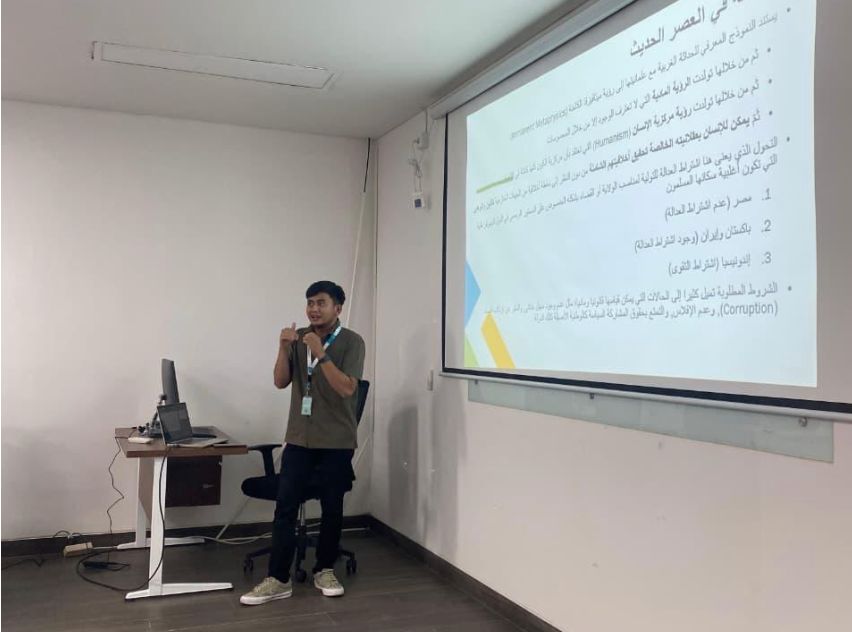
In the Decolonizing Islamic Studies panel, Arya, co-authoring with Sultan, master’s students of Turāts Batch 4, presented his paper titled “Tahqīq al-Khiṭāb al-Isti‘mārī wa al-‘Almāniyyah: Taḥawwulāt fī Ḍabṭ al-‘Adālah.” He explained that his study explores how the concept of al-‘adālah (ethic or integrity) has transformed from classical Islamic thought to the modern secular context, especially within the issues of leadership and judiciary.
“My study examines how secularism in the modern era transforms the religious dimension of life, particularly in leadership and justice,” Arya explained during his presentation.
Participating in his first international conference, Arya reflected that the meaning of ‘adālah has undergone a significant shift over time.
“In classical Islamic literature, ‘adālah is always tied to one’s religious integrity. It is usually defined as not committing major sins and not persisting in minor ones. However, in the modern context, its religious aspect has become largely detached,” he added.
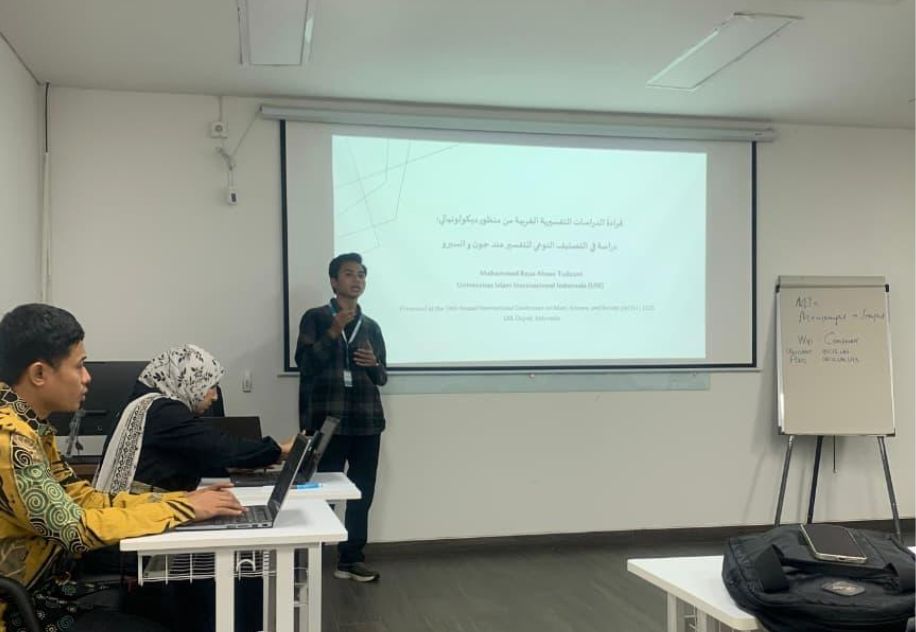
In the same panel on Decolonizing Islamic Studies, Reza, also a master student of Turāth, presented his paper “Qirā’at al-Dirāsāt al-Tafsīriyyah al-Gharbiyyah min Manẓūr Dīkūlūniyālī: Dirāsah fī al-Taṣnīf al-Naw‘ī li al-Tafsīr ‘inda John Wansbrough.” His paper reexamines John Wansbrough’s typology of Qur’anic exegesis through a decolonial perspective.
“Generally, this study explores the assumptions, methodologies, and terminologies that form the basis of Wansbrough’s typology, reanalyzing them through a decolonial framework,” Reza said.
In addition, he shared that the paper was originally his final paper in the class, which took two months to write and develop the argument.
“Actually, the paper was my final paper in the class that I wrote in one month. After that, I developed it again in one month. Yes, two months in total,” he added.
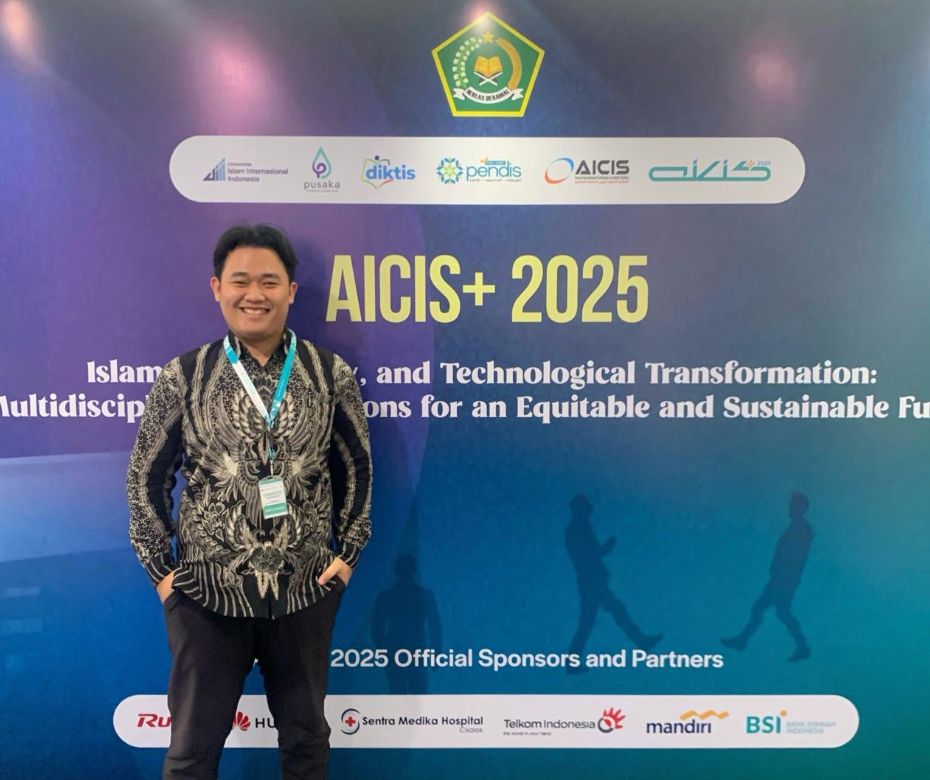
In another panel, Adam, a master’s student of Islamic Studies Regular Batch 4, presented his paper on Islamic law titled “Whose Religious Freedom? State Hegemony and the Politics of Marriage Law in Indonesia.” He highlighted the paradox within Indonesia’s marriage law system, where the state’s claim to protect religious freedom often clashes with its hegemonic control over religious institutions.
“The structural disparity in Indonesia’s marriage law is a deliberate outcome of a state hegemonic project,” Adam explained. “This hegemony was formed through a historic bloc and is reflected in the state’s institutional support for the Muslim majority, which often neglects the rights of non-Muslim minorities,” he added.
Participating in his first international conference, Adam shared that the experience was both inspiring and transformative. The feedback from the discussant also means a lot for him to improve his work.
“Being accepted as a panel presenter at an international conference for the first time was eye-opening. The plenary sessions with international scholars from diverse backgrounds, as well as the constructive feedback from the panel chair and discussant, provided valuable insights to further improve my paper,” he concluded.