Bogor — The Faculty of Islamic Studies at Universitas Islam Internasional Indonesia (UIII) conducted a community engagement program entitled “Strengthening Community through Forest Waqf Literacy” in Purwabakti Village, Pamijahan District, Bogor Regency, West Java. The program aimed to strengthen community understanding of waqf, particularly forest waqf, while encouraging community participation in environmental conservation and sustainable development. Diaz Ataya and Syukra Latif, master’s students at the Faculty of Islamic Studies, organized the program as part of their community engagement initiative.
The main activity was held on Thursday, 24 September 2026, from 08.30 to 11.00 WIB at the Green Hajj Building, Forest Waqf Zone 1, Purwabakti Village. Approximately 40 participants from Purwabakti Village attended the activity, including community members and local stakeholders.
The program began with a series of preparatory activities conducted by the FIS UIII community engagement team. One of the initial steps was an interview with local waqf officials to gain a better understanding of the history, management, potential, and challenges of the forest waqf initiative. The team also conducted a needs assessment to identify the community’s level of understanding and the educational needs related to waqf and environmental conservation.
Based on these findings, the team developed a forest waqf literacy program designed to connect the concept of waqf with practical community-based environmental conservation. The team subsequently coordinated with local stakeholders and prepared educational materials, including a forest waqf literacy module, which was later distributed to participants.
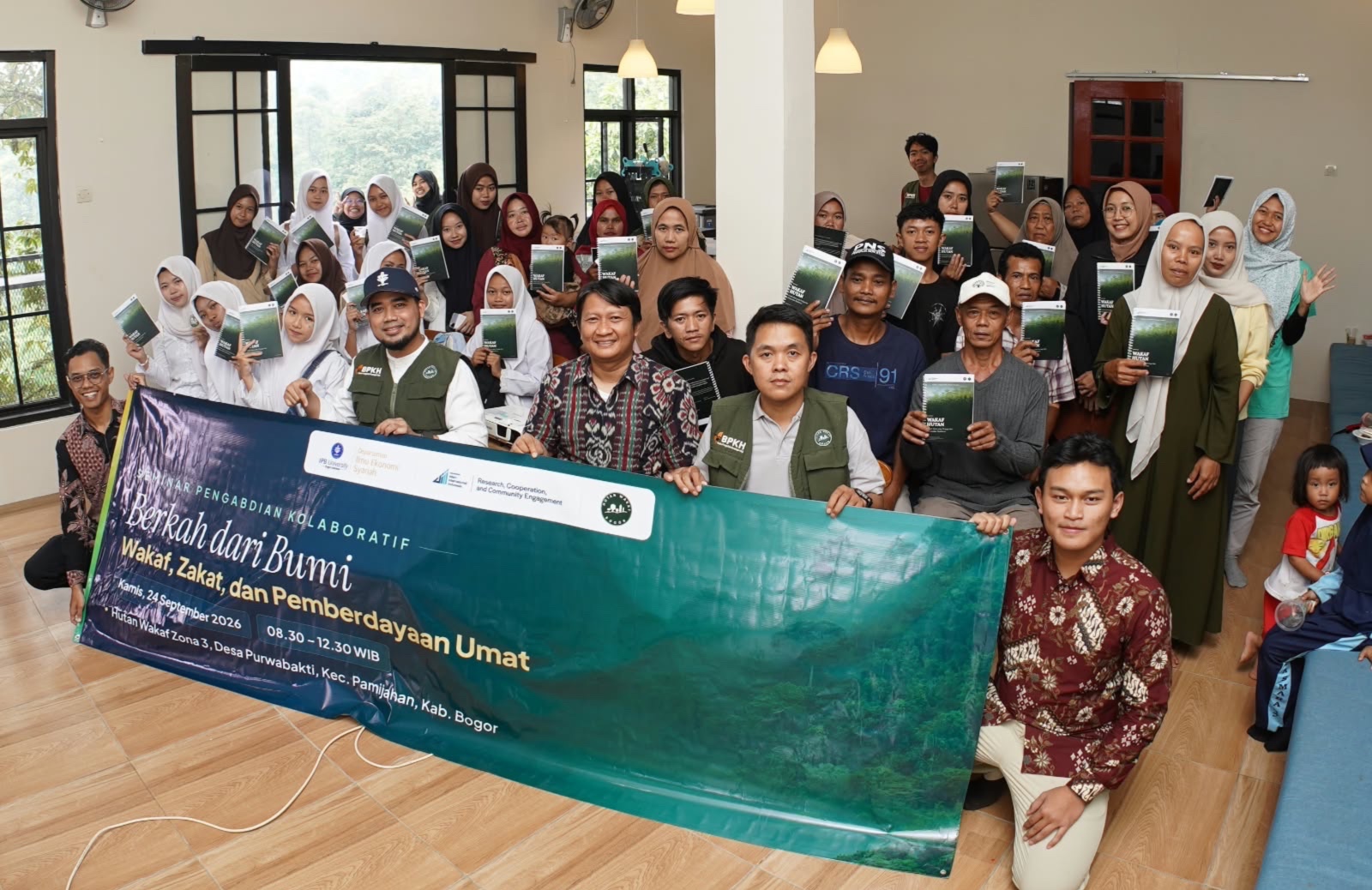
The main seminar featured two speakers who provided complementary perspectives on waqf and forest conservation. Zezen Zaenal Mutaqin, S.J.D delivered a presentation on the history and development of waqf, introducing participants to the historical role of waqf as an instrument for social welfare and community development. The session provided a foundation for understanding how waqf has evolved beyond conventional forms of charitable giving.
The second session was delivered by Dr. Khalifah M. Ali, who discussed forest waqf and its potential contribution to environmental conservation and community empowerment. The discussion highlighted how forest waqf can become a model for integrating religious values, environmental responsibility, and sustainable community development.
To evaluate the learning process, participants completed a pretest before the seminar and a post-test after the educational session. The assessment was designed to identify participants’ initial understanding of waqf and forest waqf and to observe changes in their understanding following the seminar.
The program also moved beyond classroom-based literacy through a tree-planting activity in the forest waqf area. Participants were directly involved in planting trees as a practical expression of environmental stewardship. The activity connected the ideas discussed during the seminar with concrete action to support forest conservation.
At the end of the program, the team distributed the forest waqf literacy module to the participants. The module was intended to serve as a reference that participants could use after the seminar to revisit key concepts related to waqf, forest waqf, environmental conservation, and community contribution.
The community engagement program demonstrated that forest waqf literacy can serve as a bridge between Islamic philanthropic traditions and contemporary environmental concerns. Through a combination of educational sessions, assessment, practical conservation activities, and learning resources, the program sought to encourage the community to view forest waqf not only as a religious institution but also as a potential instrument for protecting natural resources and strengthening local communities.
The activity also reflects FIS’s commitment to connecting academic knowledge with community needs. By engaging directly with local communities and stakeholders, the program sought to develop a collaborative approach in which waqf literacy and environmental awareness can contribute to sustainable community development in Purwabakti Village.